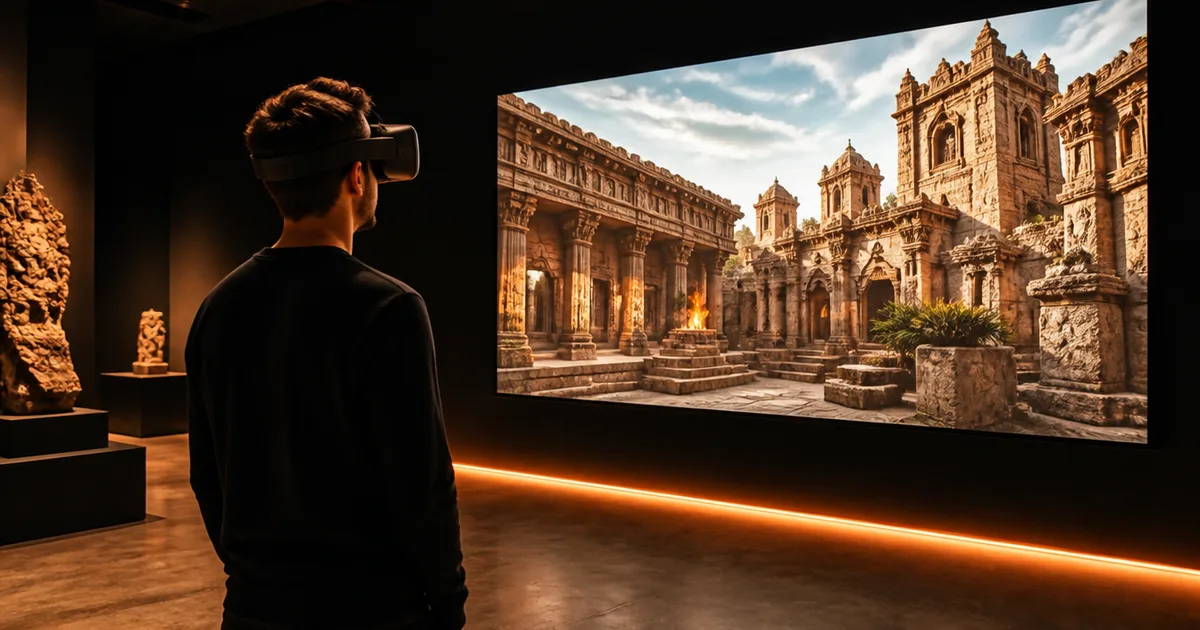
When the International Fair and Museum of the Prophet's Biography came to us, the brief was deceptively simple: bring history to life. What they actually needed was one of the most demanding production challenges we've taken on — a historically accurate, emotionally resonant VR journey through the life of the Prophet Muhammad, built for a national museum context where every architectural detail, artifact, and narrative beat would be scrutinized by scholars, religious authorities, and millions of visitors.
That project — Iman VR — taught us more about what makes immersive experiences genuinely work than almost anything else we've built. And the lessons don't stay in the museum. They transfer directly to enterprise VR: onboarding, compliance training, leadership development, safety simulation. The same discipline that makes heritage VR credible is exactly what separates enterprise training that employees remember from training they click through and forget.
The Problem With "Good Enough" in VR
Most enterprise VR training gets built backwards. The client specifies a learning objective, the studio models an environment that loosely resembles a workplace, drops in some hotspots and a quiz, and ships it. The result is technically a VR experience. It's also forgettable.
Museum VR can't get away with that. When you're reconstructing a 7th-century Arabian city for a national institution, "good enough" is not a category that exists. Scholars will identify anachronistic architectural details. Cultural advisors will flag inaccurate material representations. The institution's reputation is staked on fidelity. That pressure forces a production discipline that consumer and enterprise studios rarely apply to themselves.
The virtual museum experience market is projected to reach $25 billion by 2033, growing at 22% annually. That's not a niche. That's a signal that audiences — including enterprise audiences — have fundamentally higher expectations for immersive experiences than they did five years ago. They've been inside well-crafted VR. They know what bad feels like.
What We Actually Built for Iman VR
The scope for Iman VR covered historically accurate reconstructions of key environments from the Prophet's biography — architecture, artifacts, spatial scale, material texture, and narrative sequencing. We worked alongside historians and cultural advisors throughout pre-production. Not as a sign-off step at the end. From the beginning.
That distinction matters. In our experience, the projects that collapse under historical or factual scrutiny are the ones where subject-matter experts are brought in to review a near-final build. By that point, structural decisions are locked. You're negotiating cosmetic changes when the problem is architectural.
On Iman VR, every environment went through an evidence-tiering process before a single asset was modeled. We categorized elements into three buckets: reconstructed from primary historical sources, informed by analogous archaeological evidence, and interpretive based on period context. That framework didn't just protect historical integrity — it gave our 3D artists a clear brief for every surface, material, and spatial proportion they were building.
The photogrammetry pipeline we used for artifact reference pulled from documented archaeological specimens and museum collections. Where physical reference didn't exist, we documented our interpretive choices explicitly. The international standard for this approach — what researchers call "intellectual transparency of the reconstruction process" — exists for good reason. Audiences and institutions can tell when you've been sloppy about what you know versus what you've inferred.
The Three Disciplines That Made It Work
1. Asset Fidelity Isn't Just Visual — It's Narrative
A common mistake in VR production is treating asset quality as a visual problem. It's not. It's a trust problem.
When a user enters a reconstructed environment and something feels wrong — a material that doesn't belong to the period, a spatial proportion that breaks the sense of place — they disengage. Not consciously. They don't think "that window frame is anachronistic." They just stop believing the space. And once belief breaks, learning stops.
On Iman VR, we spent a significant portion of pre-production on material research that would never appear in a highlight reel — the texture of mudbrick walls, the way light would fall through specific architectural openings, the scale relationships between interior spaces and human figures. That investment paid off in the coherence of the final experience. Visitors weren't pulled out of the narrative by visual inconsistencies because we hadn't left any.
Enterprise application: if you're building a safety training simulation and the equipment models don't match what employees actually use on the floor, you've already lost. They'll spend cognitive energy noticing what's wrong instead of internalizing the procedure.
2. Narrative Architecture Determines What Gets Remembered
Spatial pacing is one of the least-discussed craft elements in VR production, and one of the most important. Where you place information in a physical space, how you sequence movement through environments, when you introduce a moment of stillness versus a moment of action — these decisions determine whether an experience accumulates meaning or dissipates it.
For Iman VR, we structured the journey as a series of emotionally distinct spaces. Some environments were designed for contemplative engagement — slower movement, ambient audio, close-up artifact interaction. Others were built for narrative momentum. That rhythm wasn't accidental. It came from treating the experience as you'd treat a film edit: intentional sequencing with purpose behind every transition.
In our enterprise work, this is what we brought to NBK Virtugate for the National Bank of Kuwait — a WebGL and VR onboarding experience where employees explore a virtual bank and learn procedures through avatars instead of PDFs. The client called it "a smooth, immersive onboarding experience that brings NBK's history and resources to life." That smoothness came from the same spatial pacing discipline. We didn't dump information at employees. We built an environment that delivered it in sequence, tied to physical movement through a space.
Enterprise training that doesn't think about narrative architecture produces the VR equivalent of a slide deck. Technically immersive. Functionally inert.
3. Emotional Resonance Is a Design Decision, Not a Byproduct
The most significant misconception we encounter in enterprise VR briefs is the assumption that putting someone in a headset automatically generates engagement. It doesn't. The headset removes distraction. What fills that attention is entirely dependent on what you've built.
For Iman VR, emotional resonance required deliberate choices: the scale of specific spaces relative to the human figure, the quality of ambient audio, the way narrative voiceover was timed to environmental reveals. These weren't production flourishes. They were the mechanism by which the experience moved people.
Research from enterprise VR deployments supports this. Organizations scaling VR training to more than 3,000 learners report 52% cost savings versus classroom delivery and training time reductions of 60–75%. But those numbers require experiences that employees actually engage with. The ROI on a VR training program that people rush through to reach the end-of-module quiz is not 52% savings. It's closer to zero.
What Enterprise Teams Get Wrong About Museum-Grade Production
The objection we hear most often: "That level of fidelity is for museums. We just need something functional."
We'd push back on that framing. The Empathy Lab platform we built for the UK rail industry put staff inside realistic, high-stress customer-facing scenarios to build empathy and soft skills. The environments were contemporary, not historical. But the production discipline was identical to what we applied on Iman VR — evidence-based scenario construction, spatial pacing, emotional architecture. The difference between a functional version and the version we built is whether employees carry anything out of the experience with them.
"Functional" VR training is a category that exists. It also doesn't change behavior.
The other common mistake is treating subject-matter experts as approvers rather than collaborators. On museum projects, this would be unthinkable — no institution would let a studio ship a historical reconstruction without continuous curatorial input. But in enterprise VR, L&D teams frequently hand studios a content brief and wait for a build to review. By that point, the decisions that determine whether the experience actually teaches anything have already been made, usually without the people who understand the subject matter.
The Production Framework We'd Recommend
If you're commissioning a custom VR experience — for a museum, for enterprise training, for anything where the stakes are real — here's the framework we'd apply based on what we learned building Iman VR and the projects that followed it:
Before you model anything:
- Map your evidence. What do you know with certainty? What are you inferring? What are you interpreting? Document each category separately.
- Embed your SMEs from day one. Historians, compliance officers, safety managers — whoever owns the subject matter — should be in the room when spatial and narrative decisions are made, not reviewing screenshots afterward.
- Define your emotional arc. What should someone feel at the beginning, the middle, and the end? Work backwards from that.
During production:
- Build an asset audit process. Every 3D asset should be traceable to a reference source or a documented interpretive decision.
- Test spatial pacing with real users at prototype stage, not at QA. The way people move through a space in a headset is not predictable from a flat diagram.
- Treat audio as equal to visuals. In our experience, ambient audio accounts for a disproportionate share of the sense of presence. It's consistently under-resourced.
Before launch:
- Stress-test the reset workflow. If your VR installation runs on-site with staff managing headsets, the reset process needs to be fast and foolproof. We've seen museum deployments where staff were manually resetting headsets every few minutes — that's a design failure, not a staffing problem.
- Plan for accessibility from the start, not as a retrofit. Motion sickness mitigation, seated options, audio descriptions — these need to be in the architecture, not bolted on.
After launch:
- Instrument the experience. Where do users disengage? Which environments hold attention longest? That data should feed into updates. One advantage VR has over physical museum exhibits or classroom training is that content can be updated without tearing anything down.
The Actual Differentiator
Anyone can put someone in a headset. The question is what they experience when they're in there.
The discipline that made Iman VR work for a national museum — evidence-based asset fidelity, narrative architecture, deliberate emotional pacing — is not a luxury that only cultural institutions can afford. It's the minimum required to make immersive experiences produce outcomes rather than impressions.
Enterprise teams that commission VR training as a checkbox exercise will get checkbox results. Teams that bring the same rigor to a compliance simulation that we brought to reconstructing a 7th-century city will get something employees actually carry with them.
That's the gap. And it's entirely a craft decision.