Traditional physical therapy has an adherence problem that nobody talks about honestly. Exercise sheets get filed away. Clinic appointments get skipped. Patients perform their home exercises incorrectly, without feedback, until they plateau — and then they stop. The problem is not motivation in the abstract. It is that repetitive, unsupervised, low-feedback exercise is genuinely hard to sustain, especially when progress is slow and invisible.
We built Reahap to address exactly this. It is a VR and gamification app for personalized therapeutic exercises, designed to increase patient engagement through mechanics that map directly to rehabilitation goals. Building it taught us things about the intersection of game design and clinical outcomes that no market overview captures. This post is about what we learned — and what the research confirms.
Why Engagement Is the Actual Clinical Variable
Most discussions of VR in rehabilitation focus on the technology: headset specs, tracking accuracy, visual fidelity. These matter, but they are not the primary driver of outcomes.
Research examining VR therapy populations shows that engagement functions as the critical mediator between immersion and functional recovery. The direct effect of engagement on emotional valence carries a beta coefficient of 0.26 (p < 0.001), substantially larger than the effect of spatial presence alone. Patients' natural tendency toward immersion predicts positive emotional responses — but only when engagement is actively maintained throughout the session. The implication for developers is significant: you are not optimizing for realism. You are optimizing for sustained attention and motivation across the duration of a therapeutic exercise set.
This is precisely where traditional rehab fails. A paper handout cannot adapt to a patient's performance in real time. It cannot reward a completed repetition, signal an incorrect movement pattern, or scale difficulty to prevent boredom or frustration. VR with well-designed gamification can do all of these things — and the clinical evidence shows that when it does, outcomes improve.
How We Mapped Gamification Mechanics to Therapeutic Goals in Reahap
When we designed Reahap, the starting question was not "what game mechanics are engaging?" It was "what does this patient need to do therapeutically, and what mechanic sustains that behavior?"
This distinction matters. Generic gamification — points, badges, leaderboards — applied without clinical grounding produces apps that feel like games but fail as therapy. The mechanics that consistently work in rehabilitation contexts are:
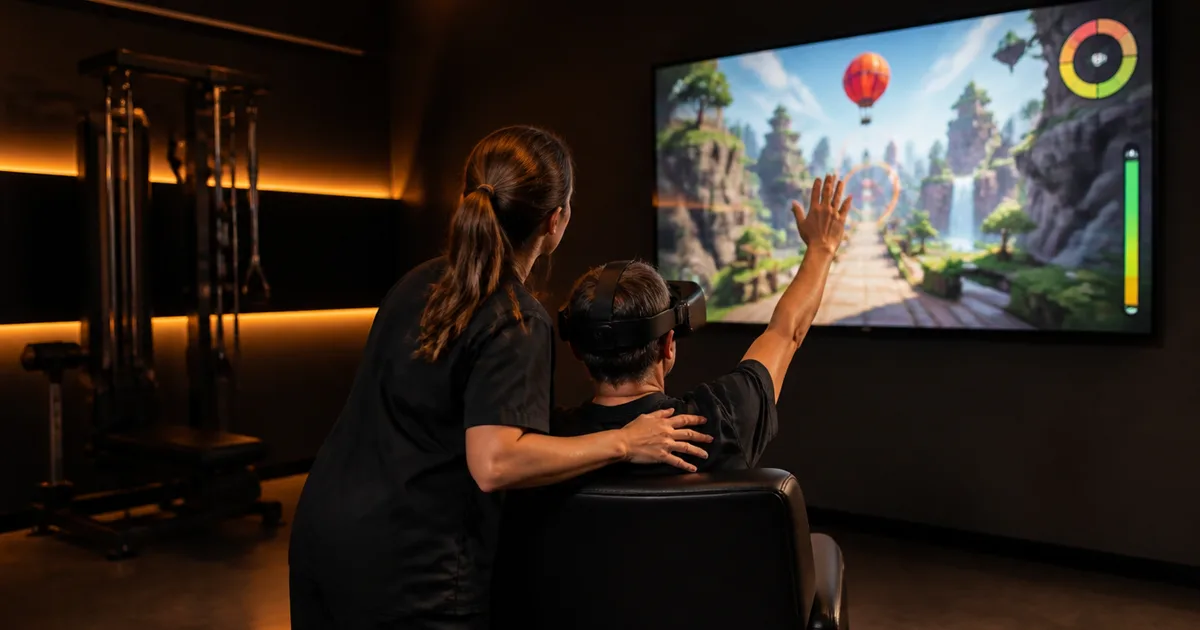
Real-time performance feedback. Visual and auditory signals tied directly to movement quality. Not just "good job" — feedback that tells the patient whether their range of motion was sufficient, whether they held the correct posture, whether their movement speed matched the target. Closed-loop feedback systems like this reinforce correct motor patterns and discourage compensation. Research supports this: feedback and progression are the gamification elements most consistently associated with improved attentional and motor outcomes across rehabilitation populations.
Adaptive difficulty calibration. The concept of flow — the psychological state where a task is challenging enough to demand focus but achievable enough to prevent abandonment — is directly applicable to physical rehab. If exercises are too easy, patients disengage. If they are too hard, they stop. In Reahap, exercise parameters adjust based on individual patient performance and capability. This is not a nice-to-have feature. It is the mechanism that prevents plateau-driven dropout, which is one of the most common failure modes in traditional home exercise programs.
Visible progression systems. Patients in rehabilitation are often working through slow, incremental functional gains that feel invisible day to day. A well-designed progression system makes those gains concrete and visible — not through inflated feedback, but through accurate tracking of performance over time. Seeing a range-of-motion metric improve from session three to session seven is motivating in a way that a therapist's verbal encouragement cannot fully replicate between appointments.
Personalization at the exercise level. Reahap generates personalized therapeutic exercise programs rather than generic protocols. This matters for two reasons. Clinically, exercises that match a patient's specific condition, strength baseline, and recovery stage produce better outcomes. Psychologically, patients who feel the program was built for them specifically show higher completion rates. Avatar customization and personal progress dashboards contribute to this sense of ownership over the recovery process.
The Tracking Infrastructure Question
One technical decision that significantly shapes rehabilitation VR outcomes is motion tracking — and it is underspecified in most vendor conversations.
Comparative analysis of tracking solutions used in VR rehabilitation shows meaningful performance differences. Optical tracking achieves the highest accuracy (approximately 1.07 cm), while electromagnetic systems, despite poor accuracy (approximately 11 cm), deliver the best jitter stability. Skeleton-based tracking shows the worst jitter values, which affects how natural visual feedback feels during movement.
For rehabilitation specifically, tracking accuracy determines whether the system can detect compensatory movement patterns — a patient favoring their dominant side, for instance, or substituting trunk rotation for limited shoulder range of motion. If the system cannot detect these patterns, it cannot provide corrective feedback, and the patient reinforces bad habits rather than correcting them. When evaluating or building a VR rehab system, tracking accuracy is a clinical requirement, not just a technical specification.
We have also followed the development of machine learning integration in this space. Reinforcement learning algorithms — Q-learning implementations in particular — have demonstrated feasibility for adjusting VR rehabilitation exercise parameters in real time based on individual kinematic data. In upper-limb reaching rehabilitation, this approach successfully adapted exercise parameters to patient capability in real time. This is the direction Reahap's adaptive difficulty architecture is oriented toward: not rule-based difficulty tiers, but continuous calibration based on actual movement data.
The Psychological Friction Problem That VR Actually Solves
Clinical settings carry psychological weight for many patients. The presence of a therapist watching, the social comparison of exercising alongside other patients, the association of the clinic environment with pain or limitation — these factors do not improve adherence. For some populations, they actively suppress it.
VR removes most of that friction. The patient is in a defined, controlled virtual environment where the only reference point is their own previous performance. There is no audience. The feedback is immediate and private. For patients dealing with chronic pain conditions, post-surgical recovery, or conditions that affect self-image around physical capability, this matters.
We saw this dynamic clearly in the Reahap development process. Patients who reported reluctance to perform exercises in clinical or group settings showed different engagement patterns in VR. The environment itself was part of the intervention design.
This also explains findings from older adult populations, where the assumption is often that VR will create technological friction and reduce engagement. Evidence shows the opposite: older adults frequently demonstrate higher engagement and satisfaction with VR rehabilitation when the interface is appropriately designed. Studies of gamified physical activity interventions in adults 60 and older showed significant increases in daily step counts and moderate-to-vigorous physical activity time. The key phrase is "appropriately designed" — user-centered interfaces, brief training sessions, and achievable goal progression structures. Modern VR rehabilitation systems can achieve user competency within approximately 30 minutes of training, which is a manageable barrier for most patient populations.
What the Clinical Evidence Actually Shows Across Conditions
The evidence base for VR rehabilitation is not uniform across conditions, and practitioners should know where it is strongest.
For stroke rehabilitation, systematic reviews show VR-based exercise produces significant improvements in Berg Balance Scale scores (mean difference 1.35, 95% CI 0.85–1.86, p < 0.00001) and Timed Up and Go performance (mean difference -0.81 seconds). Upper limb function and balance outcomes show the most consistent gains, particularly in supervised clinic settings. Home-based VR implementations show within-group improvements but less consistent advantages over active comparators — which suggests that the therapist role in modulating difficulty and selecting appropriate content remains important even when VR is the delivery mechanism.
For Parkinson's disease, VR interventions show significant improvement in Timed Up and Go performance (mean difference -2.42 seconds, 95% CI -3.95 to -0.89, p = 0.002), indicating measurable gains in dynamic balance and functional mobility.
For musculoskeletal conditions, XRHealth's retrospective analysis of 82 participants receiving VR-delivered exercise therapy for low back and neck pain showed a 17.8% reduction in Modified Oswestry Low Back Pain Disability Index scores (p < 0.001) and a 23.2% reduction in Neck Disability Index scores (p = 0.02), with no adverse events reported across all participants.
The consistent pattern across conditions: VR as an adjunct to human therapist involvement outperforms VR as a replacement for it. The technology amplifies therapeutic volume, standardizes exercise prescription, and enables remote monitoring between sessions. It does not eliminate the need for clinical judgment.
The Adoption Gap and What It Means for Product Design
Only 7.1% of licensed physical therapists currently use VR in clinical practice, despite the fact that 92.9% of non-users have been exposed to clinical evidence supporting its effectiveness. The primary barrier is not skepticism. It is workflow compatibility.
Compatibility with existing clinical workflows is the strongest predictor of adoption intention (partial correlation coefficient 0.294), significantly ahead of ease of use or patient demand. This has a direct implication for how VR rehabilitation apps should be designed: the clinician experience is not secondary to the patient experience. If a therapist cannot set up a session in under five minutes, cannot monitor patient movement data without learning a new dashboard, and cannot export outcome measures in formats that fit existing documentation systems, adoption will stall regardless of how well the patient-facing experience is designed.
In Reahap's development, we treated the therapist workflow as a first-class design problem. Personalized programs need to be configurable by the clinician, not just by the patient. Outcome tracking needs to produce data the therapist can use in progress notes and payer documentation. The VR experience is what the patient sees; the clinical infrastructure is what determines whether the product gets used.
A Practical Framework for Evaluating or Building a VR Rehab Application
If you are a healthcare director, digital health product lead, or clinical technology evaluator assessing a VR rehabilitation platform — or commissioning one — here is what to examine:
Clinical design validation
- Are gamification mechanics mapped to specific therapeutic goals, or applied generically?
- Does adaptive difficulty calibration adjust based on real kinematic data, or fixed difficulty tiers?
- Is the feedback loop closed — does the system detect and respond to incorrect movement patterns?
Technical infrastructure
- What tracking technology is used, and what is the documented accuracy in centimeters?
- Is the system capable of capturing and exporting kinematic data for clinical review?
- What is the latency profile, and does it meet thresholds that prevent cybersickness in target populations?
Personalization and plateau prevention
- Does the system generate individualized exercise programs, or deliver standardized protocols?
- How does the system respond when a patient plateaus on a given exercise parameter?
- Is progression visible to the patient across sessions, not just within a single session?
Clinician workflow integration
- How long does setup take per patient session?
- Can therapists configure, monitor, and adjust programs without extended training?
- Does the platform produce documentation compatible with existing outcome measurement and payer requirements?
Safety and contraindication screening
- Is there a validated screening protocol for cybersickness susceptibility prior to use?
- What adverse event protocols exist for balance rehabilitation sessions?
- Has the system been tested with the specific clinical populations you intend to serve?
Building Reahap confirmed what the clinical literature increasingly shows: the technology is not the hard part. The hard part is understanding why patients stop — and designing every mechanic, every feedback signal, and every adaptive parameter specifically to prevent that moment. That is what separates a VR rehabilitation app that produces outcomes from one that produces demos.
If you are building or evaluating a VR rehabilitation platform and want to discuss the technical and clinical design decisions involved, we are straightforward to reach.