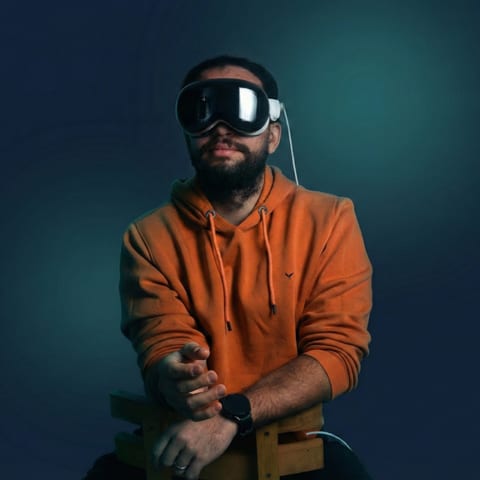

A unity vr prototype for enterprise sales demo is almost never scoped correctly on the first brief. The mental model that arrives in the first meeting is shaped by the last polished trade-show spectacle the client saw — photorealistic, fully interactive, standalone, ready in weeks. What the scoping conversation reveals is that a sales demo and a training simulation are governed by entirely different success criteria, and those criteria reshape every build decision before a single Unity scene is opened.
This post uses Veem as its anchor example and maps the production decisions that separate a VR sales prototype that moves pipeline from one that impresses once and collects dust.
What Veem Reveals About Scope Under Pressure
Veem — VR retail metaverse where users browse stores, socialize, and purchase in a virtual world — is the kind of project that exposes the hidden complexity of "simple" social commerce in VR. The client said: "Dedicated team, disciplined, hard-working and above all knowledgeable. Managed to complete despite challenges and tight timeframe."
That description — challenges, tight timeframe, completion — is the honest summary of most enterprise VR builds. The challenges are rarely exotic. They are the ordinary collision of ambitious scope, real hardware constraints, and the social and transactional requirements that make a commerce environment fundamentally harder than a single-user walkthrough. Social presence, avatar synchronisation, multi-user networking, and purchase flows each add load that competes directly with asset fidelity and frame rate.
For a sales demo context, Veem's architecture illustrates a core principle: the axis of optimisation is not visual richness, it is whether the experience communicates its value proposition reliably under imperfect conditions. A retail metaverse must convey spatial browsing, social engagement, and transactional confidence — not necessarily photorealistic shelving. The same logic applies to any unity vr prototype for enterprise sales demo: identify the one or two things the prospect must feel or understand, and protect those above everything else.
The Four-Minute Success Criterion That Reshapes Every Build Decision
The standard success metric for a VR training simulation is measurable: completion rate, task accuracy, retention score. For a unity vr prototype for enterprise sales demo, the metric is behavioural: did the prospect stay voluntarily engaged for roughly four to six minutes, and did they remove the headset asking a question that signals genuine interest in the offer — about integration, scalability, or cost — rather than about the novelty of VR itself?
That criterion sounds simple. It is not. It means:
- Narrative must front-load the value proposition. The core "why this matters" must land within the first sixty to ninety seconds, before cognitive load from unfamiliar controls accumulates.
- Onboarding overhead must be near zero. A prospect wearing a headset for the first time, possibly in a social setting, will not invest effort in learning a control scheme. Gaze-based selection, minimal button mapping, or guided-rail navigation are not compromises — they are correct choices for this context.
- The handoff moment must be designed before the first scene is opened. What does the salesperson say the instant the headset comes off? What shared reference point does the experience create? If that conversation is not designed in advance, the demo becomes a novelty rather than a sales tool.
This reframes the entire brief. The question is not "how much can we simulate?" It is "how reliably can we elicit targeted curiosity in four to six minutes under imperfect conditions?"
Why Interaction Depth Is the Wrong Axis for a Unity VR Prototype for Enterprise Sales Demo
Unity's XR Interaction Toolkit encourages experimentation — object manipulation, physics, branching scenarios, complex UI. The instinct to "make it more interactive" is reinforced by a general belief that active engagement is better than passive observation. In training contexts, that instinct is often correct. In a sales context, it frequently misfires.
Every additional interaction mode — grabbing, rotating, teleporting, menu browsing — adds onboarding overhead. In a four-to-six-minute window, that overhead is not free. It consumes the attention budget that should be spent on the value story. It also widens the gap between novice and experienced users, making the demo inconsistent across sales calls. Sales leadership needs predictable experiences that individual salespeople cannot easily derail.
A practical threshold for interaction depth in a sales demo covers three goals:
- Let the user directly experience at least one core affordance that would be hard to convey in 2D — the scale of industrial equipment, the spatial flow of a retail environment, the behaviour of a system under stress.
- Give the salesperson a shared embodied reference point to anchor the post-demo conversation.
- Create one moment of meaningful agency where the prospect feels they caused something to happen.
Beyond those three goals, additional interaction tends to deliver diminishing returns. This is not a rule against complexity — it is a constraint derived from the session length and the cognitive state of a first-time headset user in a sales environment.
The contrarian case exists: when the product's primary value proposition is its interactive sophistication — a complex industrial control system, a configurable simulation platform — then thin-veneer interactivity would undercut credibility. But even then, the demo should offer "thin slices" of deep functionality rather than exhaustive procedural replication. Hint at the depth; do not require the prospect to traverse it.
Iman VR demonstrates the alternative template at the extreme end: an immersive reconstruction for a museum exhibition that holds visitor attention without any gamified reward loop, relying instead on environmental fidelity, spatial storytelling, and carefully orchestrated narrative pacing. The absence of explicit scoring or achievements demonstrates that VR can sustain attention through meaning and emotion rather than through mechanics alone.
Asset Fidelity, Platform Choice, and What Actually Ships
The most common mismatch between brief and delivered build is on asset fidelity. Enterprise clients arrive expecting photorealism. What ships is almost always a hybrid: hero assets with higher fidelity surrounded by stylised or simplified environments. Understanding why requires understanding the platform decision.
Standalone-first is the dominant choice for field sales contexts. It eliminates PC transport, cabling, and driver management. The trade-off is a tighter performance budget. Standalone mobile-grade hardware imposes hard limits on polygon counts, texture resolutions, real-time lighting, and physics simulation. Teams building for standalone typically rely on baked lighting, aggressive level-of-detail strategies, and occlusion culling. Unity's Universal Render Pipeline helps, but it does not eliminate the constraint — it makes it more manageable.
Tethered-first opens up substantially more headroom: volumetric effects, real-time reflections, higher-density environments. It is appropriate for controlled flagship environments — corporate innovation centres, executive briefings — where dedicated technical staff manage setup. The logistical overhead is real, and in some enterprise environments, security policies complicate transporting PCs with proprietary code into client facilities.
The deployment environment shapes the fidelity decision as much as the hardware does:
- Conference floor: Ambient noise, visual distraction, and time pressure are high. Fidelity beyond a functional threshold offers diminishing returns because user attention is fragmented. Robustness to interruption and zero-friction onboarding matter more than subtle PBR materials.
- Boardroom: More focused attention, longer potential session, higher consequence of technical failure. Slightly higher fidelity can pay off, but error handling and fallback flows become critical.
Unity simulations and Unity digital twin workflows inform how teams approach the fidelity question in industrial and infrastructure sales demos. A simplified or static subset of a digital twin — showing how a facility responds to a parameter change, for instance — can be more persuasive than a fully interactive replica, because it surfaces the right information without requiring the prospect to operate unfamiliar controls. Unity Industries templates provide starting points for these verticals that align with domain expectations.
For social or multi-user demos, as Veem illustrates, the fidelity budget must also account for avatar rendering, networking overhead, and synchronisation. A stylised world that communicates brand identity and spatial layout reliably is more valuable than a photorealistic environment that drops frames when a second user enters the scene.
Scope Drivers a Brief Must Resolve Before a Studio Opens Unity
The gap between an accurate estimate and a wildly optimistic one almost always traces back to unresolved scope drivers in the initial brief. A unity vr prototype for enterprise sales demo tutorial or template can scaffold basic interaction patterns, but it cannot resolve the decisions that determine actual build complexity. Before a studio should open Unity, the brief needs to answer:
1. What is the primary sales outcome? What specific question should the prospect ask when the headset comes off? If the team cannot answer this, the experience has no design target.
2. What is the deployment environment? Trade show, boardroom, or field sales kit? Each implies different hardware, different fidelity budgets, and different robustness requirements.
3. What is the target platform? Standalone-first or tethered-first? Cross-platform support adds significant complexity and should be phased unless the timeline and budget explicitly accommodate it.
4. What is the maximum session length? This determines narrative structure, interaction complexity, and how much content can realistically be included.
5. Are existing 3D assets available? Bespoke photorealistic asset creation is frequently the largest single cost driver. If the client has existing CAD files, product renders, or brand assets, the scope changes materially.
6. Are there brand, compliance, or sensitivity constraints? Healthcare, finance, and public infrastructure demos may require specific content handling, data privacy considerations, or approval workflows that add time regardless of technical complexity.
Unity SLAM capabilities become relevant when the demo involves mixed reality or passthrough features — understanding the limits of spatial tracking under trade show lighting or complex interiors informs whether a demo should lean on MR features or stay within a fully virtual environment. Unity for architecture workflows inform spatial layout and navigation design. Unity educational games design principles — scaffolding, clear objectives, minimal cognitive overload — are useful references for structuring the narrative arc, even if overt gamification is inappropriate for the sales context.
Three Lessons from the Research Data
Lesson 1: The success metric determines the design grammar. Training simulations and sales demos share tools but not objectives. A unity vr prototype for enterprise sales demo is closer to an embodied pitch deck than to a simulator. Every design decision — interaction depth, asset fidelity, session length, navigation model — should be evaluated against whether it helps a prospect grasp the value proposition and ask a pipeline-moving question, not against whether it is technically impressive.
Lesson 2: Standalone-first is a constraint, not a compromise. The majority of enterprise field sales deployments target standalone hardware for logistical reasons. Accepting that constraint early — and designing the experience within it rather than against it — produces more reliable demos than attempting to port a tethered build down to mobile-grade hardware after the fact. The performance budget shapes narrative pacing, asset strategy, and interaction design from day one.
Lesson 3: The handoff moment is a design deliverable. What happens when the headset comes off is as important as what happens inside it. The experience architecture must anticipate and shape the transition back to face-to-face dialogue. The final scene, the last interaction, and the emotional state the prospect is in when they remove the headset are not afterthoughts — they are the point. Studios that treat the post-demo conversation as out of scope consistently produce experiences that impress once and then collect dust.
Related Reading
- VR Development: Hub — the full cluster covering Unity, XR platforms, and enterprise deployment
- Custom VR Experience Development: Museum Lessons for Enterprise — how museum-grade narrative design applies to enterprise contexts
- Unity vs Unreal for Enterprise VR Training — platform comparison for teams choosing an engine
- How to Publish a VR App on the Meta Quest Store — deployment considerations for standalone headsets
- Veem project case study — VR retail metaverse built for social browsing and purchase
If your team is scoping a unity vr prototype for enterprise sales demo and wants a build that moves pipeline rather than one that collects dust after the first trade show, talk to the Virtual Verse Studio team. Bring the six brief questions above to the first call and the estimate will be accurate.