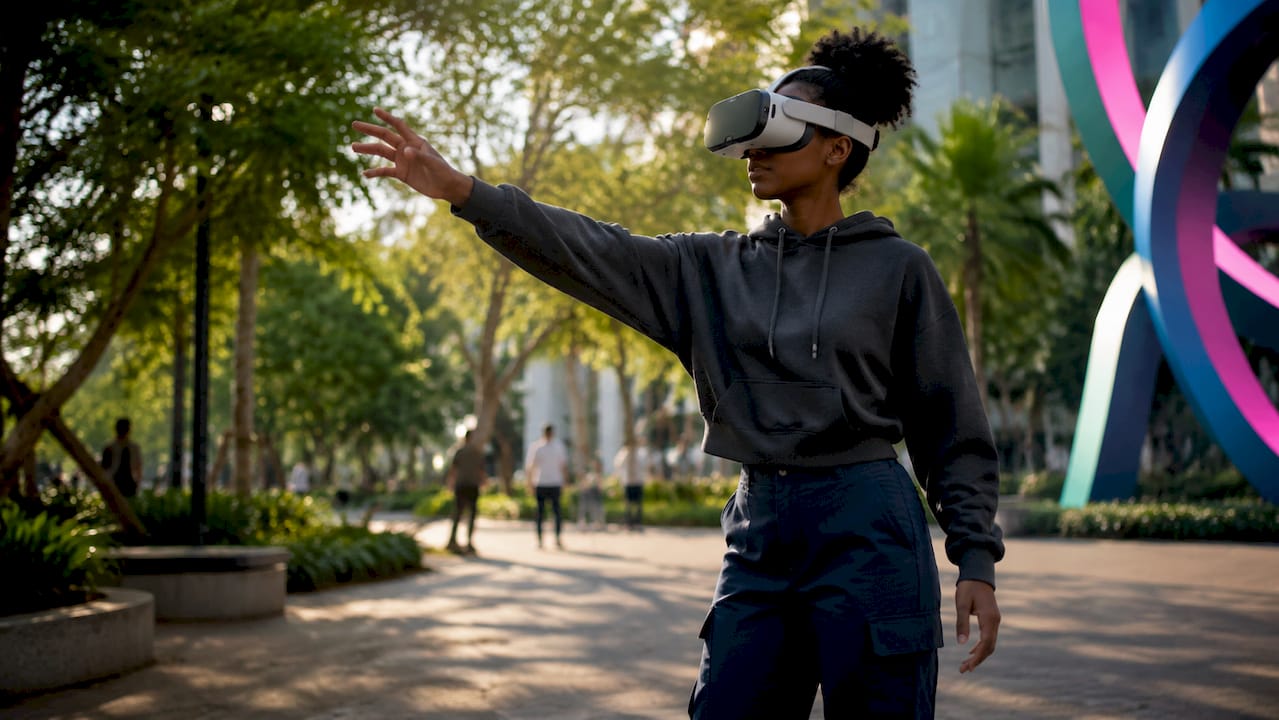
Scenario-based VR training is defined as an immersive learning method where employees engage in realistic virtual environments that require active decision-making, judgment, and problem-solving under simulated consequences. Unlike passive e-learning modules, this approach places learners inside the situation rather than in front of it. Enterprise VR programs deliver 75% retention rates, 4x faster completion, and 275% higher learner confidence than traditional methods. Those numbers explain why L&D teams at Fortune 500 companies have moved from pilot programs to full-scale rollouts. Platforms like PIXO VR and studios like Virtualverse now build these experiences end-to-end for enterprises across healthcare, banking, retail, and manufacturing.
What is scenario-based VR training and how does it work?
Scenario-based VR training works by placing a learner inside a three-dimensional, interactive environment where every choice produces a visible consequence. The learner is not reading about a difficult customer conversation or watching a safety video. They are standing in the scenario, making the call, and experiencing the result in real time.
The neuroscience behind this is well-documented. Contextual encoding creates stronger, more durable memory pathways by embedding learning in the same sensory and emotional context where the skill will eventually be used. When a learner later faces a real-world situation that mirrors the VR scenario, the brain retrieves the associated knowledge faster and more accurately than it would from a slide deck or a quiz.
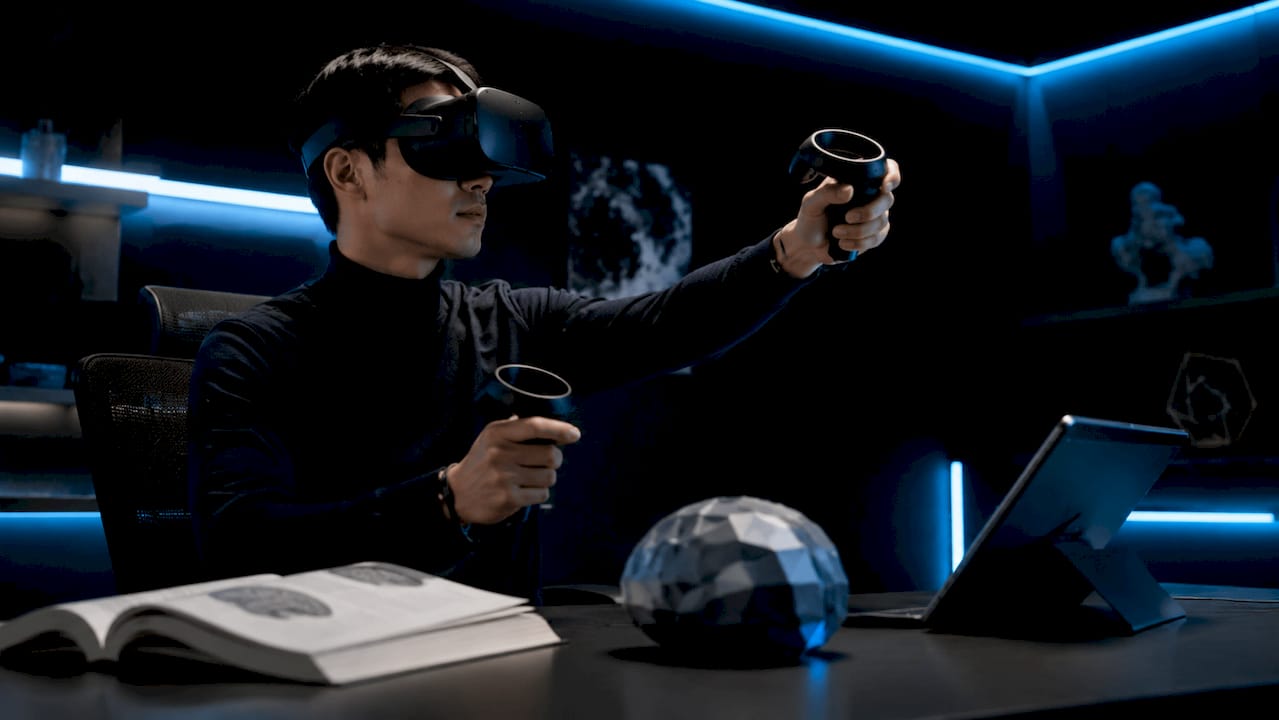
Active retrieval reinforces this effect. Every decision point in a well-designed VR scenario forces the learner to access and apply knowledge rather than passively receive it. Scenario-based learning engages the brain's story, decision, and consequence processes simultaneously, which is precisely what slides and quizzes cannot replicate.
Emotional engagement is the third mechanism. When a VR scenario carries realistic stakes, such as a simulated chemical spill or a hostile customer interaction, the affective learning centers activate. Embedding emotional stakes and realistic consequences in VR produces better retention and transfer than traditional approaches because the brain treats the experience as real enough to remember.
Pro Tip: Design your scenarios so that the emotional stakes are visible within the first 30 seconds. If the learner does not feel the weight of the situation immediately, the affective engagement that drives retention never activates.
Benefits of scenario-based VR training vs. traditional methods
The performance gap between VR-based scenario training and conventional classroom or e-learning formats is measurable and consistent across industries.
- Retention: VR training programs achieve 75% retention versus roughly 10% for passive reading-based formats. Higher retention means fewer repeat training cycles and faster time to competency.
- Speed: Learners complete VR-based modules up to 4x faster than equivalent classroom instruction. For high-frequency tasks in retail service or manufacturing, that compression translates directly to reduced training costs.
- Confidence: Learner confidence scores run 275% higher after VR training than after traditional instruction. Confidence predicts on-the-job performance, particularly in high-pressure or safety-critical roles.
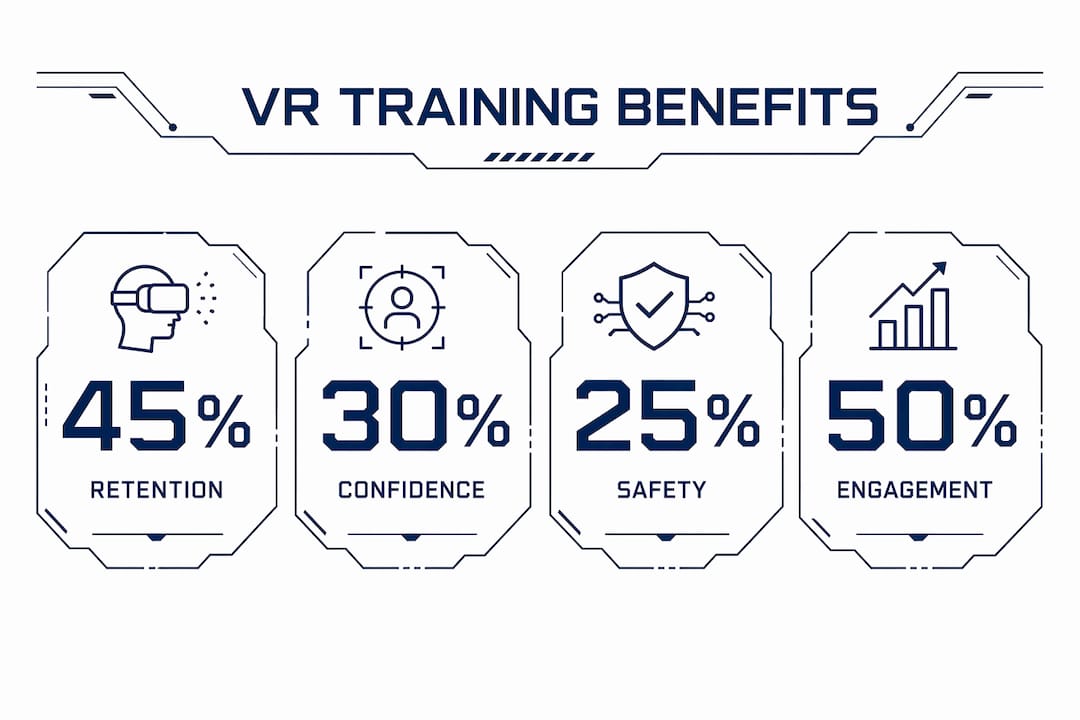
- Safety outcomes: Safety-focused VR training reduces incident rates by 25–30% in the first year of implementation. That reduction carries direct financial value through lower workers' compensation claims and OSHA penalties.
- ROI timeline: VR training adoption now shows payback under 18 months for high-frequency tasks, with implementation costs ranging from $75,000 pilots to multi-million full rollouts depending on scale.
The comparison with e-learning deserves specific attention. Standard e-learning delivers information efficiently but does not build judgment. A compliance module can confirm that a learner read the policy. A VR scenario can confirm that the learner made the right call under pressure. For skills where judgment matters, that distinction is the entire argument for VR.
Which types of scenario-based VR training work best?
Scenario-based VR training spans compliance, customer service, safety, leadership, and sales, with the strongest results concentrated in situations where judgment matters and mistakes carry real consequences. Procedural tasks with no decision complexity, such as data entry or simple assembly, are less suited to this method.
The table below maps the primary scenario types to their learning objectives and optimal enterprise use cases.
| Scenario Type | Learning Objective | Best Use Case |
|---|---|---|
| Compliance scenarios | Policy application under pressure | Financial services, healthcare, HR |
| Safety simulations | Hazard recognition and emergency response | Manufacturing, construction, energy |
| Customer service role-plays | De-escalation and communication | Retail, hospitality, contact centers |
| Leadership decision-making | Judgment under ambiguity | Management development programs |
| Sales simulations | Objection handling and closing | B2B sales teams, real estate |
VR is most effective for what researchers classify as open skills: tasks involving complex motor demands, social judgment, or high-stakes decisions that are too risky or costly to practice in live environments. A new bank employee practicing a hostile customer interaction in VR carries zero risk to the actual customer relationship. A surgeon trainee rehearsing a procedure in a VR simulation carries zero risk to a patient.
VR is less effective when procedures change frequently. If the correct steps for a compliance task are revised quarterly, the cost of updating immersive 3D environments may outweigh the retention benefit. In those cases, a well-structured e-learning module or job aid is the more practical choice.
Pro Tip: Before commissioning a VR scenario, ask whether the skill requires judgment or just recall. If a learner can pass a written test and perform correctly on the job, VR adds cost without proportional benefit. Reserve VR for the skills where judgment under pressure is the actual competency being developed.
VR training applications across enterprise functions
The range of VR training applications in enterprise settings has expanded well beyond safety and compliance. The following use cases represent the highest-impact deployments currently in production.
- Safety and OSHA compliance: Manufacturing and construction firms use VR simulations to rehearse emergency evacuations, equipment lockout procedures, and hazard identification. The repeatable, consequence-free practice environment is the core value proposition here.
- Customer service and de-escalation: Retail and hospitality organizations deploy branching VR scenarios where employees practice handling aggressive customers, service failures, and sensitive conversations. Virtualverse built Empathy Lab for UK rail specifically to develop soft-skills in frontline staff through immersive VR role-play.
- Sales and negotiation: B2B sales teams use VR to rehearse discovery calls, objection handling, and closing conversations with AI-driven virtual buyers. The ability to repeat the same scenario with different variables accelerates skill development faster than live call shadowing.
- Onboarding and culture immersion: Enterprises use VR to introduce new hires to physical facilities, team structures, and company values before their first day on site. Virtualverse's NBK Virtugate project delivered gamified bank onboarding through a combined WebGL and VR platform.
- Healthcare and clinical training: Hospitals and medical device companies use VR for procedural rehearsal, patient communication training, and emergency response drills. The Immersive Exposure platform demonstrates how contextual encoding principles translate directly into clinical and educational settings.
- Leadership development: Senior leadership programs use branching decision scenarios to rehearse crisis communication, team conflict resolution, and strategic prioritization under simulated time pressure.
The common thread across all of these applications is the same: the skill being developed requires judgment, not just knowledge. VR creates the conditions for judgment to be practiced safely, repeatedly, and with measurable outcomes.
Key takeaways
Scenario-based VR training delivers measurable gains in retention, confidence, and safety outcomes because it forces active judgment in realistic contexts, not passive information consumption.
| Point | Details |
|---|---|
| Definition and core mechanism | Scenario-based VR training places learners in realistic virtual environments where decisions produce visible consequences. |
| Retention and speed advantage | VR programs achieve 75% retention and 4x faster completion compared to traditional classroom instruction. |
| Best fit for open skills | VR delivers the strongest results for judgment-intensive tasks like safety, de-escalation, and leadership decisions. |
| Scenario design determines outcomes | Plausible-but-wrong choices and bottleneck branching architecture matter more than the technology platform itself. |
| ROI is measurable | Safety-focused VR training reduces incident rates by 25–30% in year one, with payback under 18 months for high-frequency tasks. |
What I've learned designing scenario-based VR training
The most common mistake enterprises make when commissioning VR training is treating the technology as the product. The headset is not the training. The scenario is.
Scenario design quality determines training effectiveness far more than the rendering quality of the environment. The critical design decision is the quality of the wrong answers. If every incorrect choice is obviously wrong, the learner is not practicing judgment. They are practicing elimination. The wrong options need to reflect the actual mistakes real employees make in real situations. That requires subject matter expert interviews, not just instructional design templates.
The second lesson is architectural. Bottleneck nodes that limit branching depth to 2–3 meaningful decisions before reconverging keep the scenario manageable and measurable. Infinite branching sounds thorough but produces scenarios that are expensive to build, impossible to analyze, and exhausting to complete. The goal is to measure judgment at specific decision points, not to simulate every possible conversation path.
The third lesson is iteration. The first version of any scenario is wrong in ways you cannot predict until real learners run through it. Build in a structured feedback loop from the first cohort before scaling deployment. The learners will surface ambiguities in the choices, gaps in the context, and pacing problems that no amount of internal review will catch.
— Mazen
How Virtualverse builds enterprise VR training that performs
Virtualverse designs and builds custom enterprise VR training for organizations that need more than an off-the-shelf module. The studio's work spans safety simulations, soft-skills role-plays, onboarding experiences, and leadership development scenarios, all built end-to-end from concept through QA and deployment.
Delivered projects include Empathy Lab, a VR soft-skills training platform for UK rail frontline staff, and NBK Virtugate, a gamified onboarding experience combining WebGL and VR for a major bank. The studio's full XR development services cover Meta Quest, Apple Vision Pro, WebGL, and PC platforms, with Unity as the primary engine. If you are evaluating scenario-based VR training for your enterprise and need a development partner with documented L&D outcomes, Virtualverse is the place to start the conversation.
FAQ
What is scenario-based VR training?
Scenario-based VR training is an immersive learning method where employees practice decision-making and problem-solving inside realistic virtual environments. Every choice produces a consequence, which builds judgment and retention faster than passive instruction.
How does scenario-based training differ from standard e-learning?
Standard e-learning delivers information and tests recall. Scenario-based VR training forces active judgment under simulated pressure, producing 75% retention versus roughly 10% for passive reading-based formats.
Which industries benefit most from VR training applications?
Manufacturing, healthcare, retail, financial services, and construction see the strongest results because their highest-risk skills involve judgment under pressure, which is exactly where VR simulations outperform classroom and e-learning methods.
How long does it take to see ROI from VR training?
VR training programs show payback under 18 months for high-frequency tasks, with safety-focused deployments reducing incident rates by 25–30% in the first year.
What makes a scenario-based VR training program effective?
Scenario design quality determines outcomes more than technology. Effective programs use plausible-but-wrong answer choices, bottleneck branching limited to 2–3 decision nodes, and iterative testing with real learner cohorts before full deployment.
Recommended
- VR for Corporate Training: A 2026 Buyer's Guide | Virtual Verse Studio Blog
- Building VR Training for Employees: The Parts Nobody Documents | Virtual Verse Studio Blog
- Building VR De-Escalation Training for Employees: The Parts Nobody Documents | Virtual Verse Studio Blog
- Unity vs Unreal for Enterprise VR Training: An Agency Perspective | Virtual Verse Studio Blog