
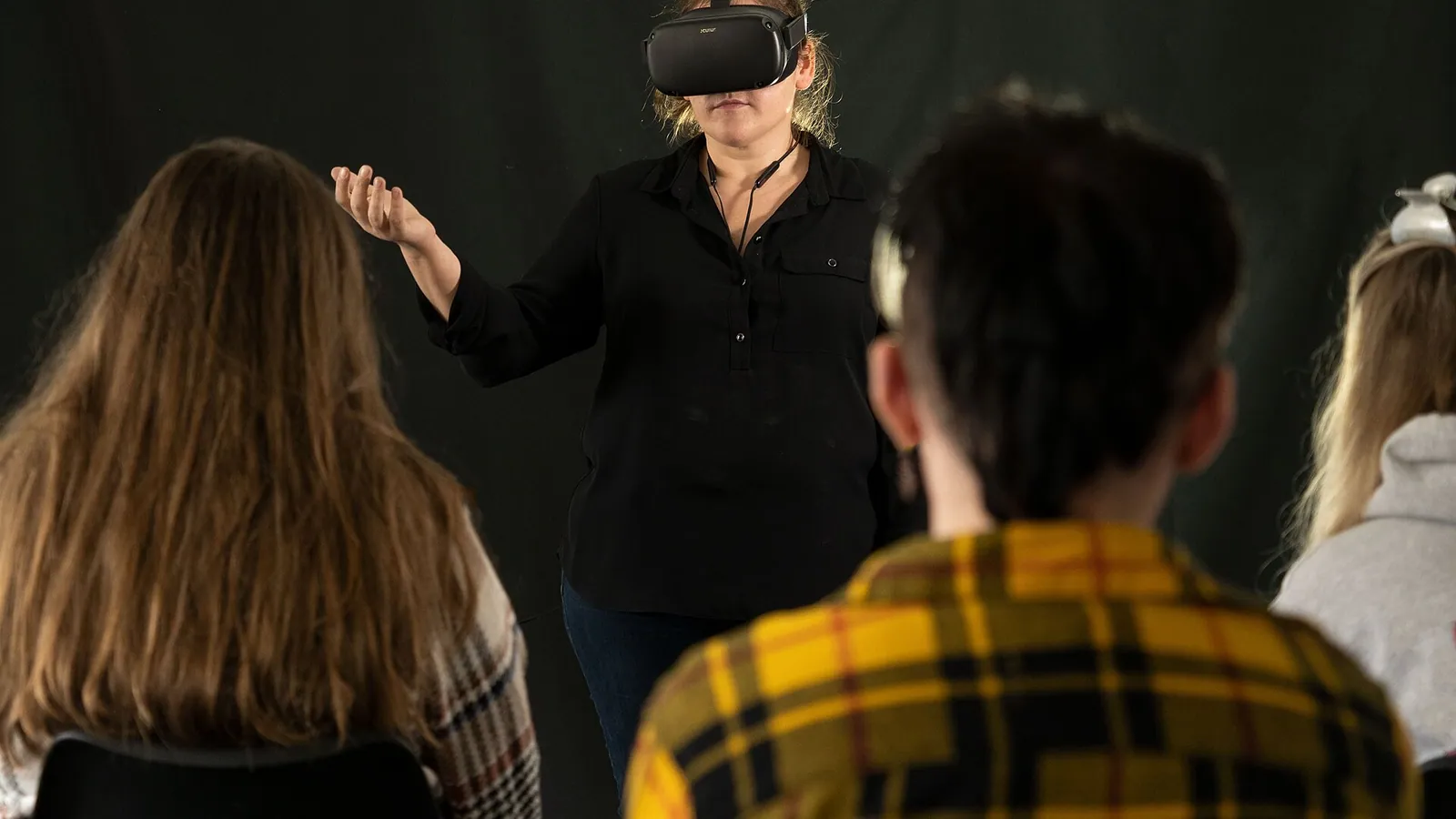
If you are weighing VR onboarding vs e-learning, the honest answer is that neither wins outright — they win in different situations. VR onboarding is faster and far more memorable for skills people have to practice. E-learning is cheaper, quicker to update, and unbeatable for delivering knowledge at low headcount. We have built both kinds of onboarding for enterprise clients, and the decision almost always comes down to three numbers: speed, retention, and how many people you are training.
This guide compares the two head-to-head on those exact dimensions, grounds the trade-offs in PwC's research, and tells you plainly when e-learning is the smarter choice.
VR Onboarding vs E-Learning: The Short Answer
The fastest way to choose is to look at speed, retention, and cost together. In PwC's 2020 enterprise study, employees completed VR training 1.5x faster than e-learning and 4x faster than the classroom (PwC, 2020). But that speed comes with higher upfront cost, so the right tool depends on your situation, not on which technology is newer.
Here is the head-to-head at a glance. Treat it as a decision aid, not a ranking — each row matters more or less depending on what you are onboarding people to do.
| Dimension | VR onboarding | E-learning |
|---|---|---|
| Completion speed | 1.5x faster than e-learning | Baseline |
| Confidence to act | 275% more confident (35% over e-learning) | Strong for knowledge, weaker for action |
| Emotional connection | 2.3x more connected than e-learners | Lower for experiential content |
| Upfront build cost | Higher (3D + interaction design) | Lower |
| Cost parity point | Reaches parity with e-learning at ~1,950 learners | Cheaper below that threshold |
| Update speed | Slower (rebuild scenes/interactions) | Fast (swap slides, text, video) |
| Best for | Practice, high-stakes, repeatable moments | Knowledge, policies, frequent changes |
The pattern is consistent: VR's advantages are real but concentrated in practice-heavy, high-stakes onboarding at scale. For everything else, e-learning's lower cost and faster updates usually win.
Is VR Onboarding Faster Than E-Learning?
Yes, measurably. PwC's study found employees completed VR training 1.5x faster than e-learning and 4x faster than classroom instruction (PwC, 2020). The gain is largest for skills that require doing rather than reading, because a simulation lets people rehearse the actual moment instead of clicking through a description of it.
Where does that speed come from? Mostly from removing the gap between learning something and applying it. In e-learning, a new hire reads how to handle a difficult customer, then meets one weeks later with no rehearsal. In VR onboarding, they handle a simulated version on day one. The practice is the lesson, so there is no second step where knowledge has to be translated into behavior.
But the speed advantage shrinks fast for pure recall. If onboarding is "memorize these ten policies," VR adds production cost without adding much speed over a well-built e-learning module. We have turned down VR scope for exactly this reason: when the goal is knowledge transfer, an interactive e-learning course gets people to the same place sooner and cheaper.
Does VR Onboarding Improve Retention and Confidence?
This is VR's strongest claim. PwC found VR-trained learners were 275% more confident to act on what they learned — a 40% lift over classroom and a 35% lift over e-learners (PwC, 2020). Confidence to act is exactly what onboarding is supposed to produce, and it is where passive content struggles most.
The mechanism appears to be emotional. PwC measured VR learners as 3.75x more emotionally connected to the content than classroom learners and 2.3x more than e-learners (PwC, 2020). Emotion drives memory. A scenario you felt nervous in sticks; a slide you skimmed does not. That is why immersive and experiential methods tend to retain materially more a year on than passive ones, which is the core argument for VR in high-stakes onboarding (ArborXR).
Here is the part that gets overlooked. The retention edge is not free, and it is not universal. It shows up where the content is inherently experiential: a first customer conversation, a safety-critical procedure, a high-pressure decision. For a list of facts, e-learning with good spaced-repetition quizzing can hold knowledge nearly as well at a fraction of the cost. The honest framing is that VR buys retention specifically for the moments that are hard to replicate any other way.
When Is E-Learning the Better Choice for Onboarding?
Often, frankly. E-learning is the better choice whenever cost, update speed, or sheer reach matters more than immersion — and that covers a large share of real onboarding. The deciding number is cost parity: PwC found VR reaches cost parity with e-learning only at about 1,950 learners (PwC, 2020). Below that, e-learning is usually cheaper per head.
Three situations where we steer clients toward e-learning, not VR:
- Low headcount. If you are onboarding 80 people a year, VR rarely pays back. The 3D production cost is spread across too few learners to beat a solid e-learning course.
- Content that changes often. Policies, product details, and org charts get revised constantly. Updating an e-learning slide takes minutes; rebuilding a VR scene takes a sprint. Volatile content belongs in e-learning.
- Pure knowledge checks. When onboarding is mostly "read this, pass this quiz," immersion adds no behavioral value. E-learning delivers and assesses knowledge faster and cheaper.
There is also a hybrid trap worth naming. Some buyers assume VR has to replace e-learning. It does not. The strongest programs we build keep e-learning for knowledge and add VR only for the handful of moments that genuinely need to feel real. That is usually the most cost-effective design, not an all-or-nothing bet on either format.
How Cost Decides Between VR Onboarding and E-Learning
Cost is the variable that settles most of these debates. VR onboarding carries higher upfront cost because it needs 3D content and interaction design, but its per-learner cost drops as the population grows. PwC found VR reaches cost parity with classroom at 375 learners and with e-learning at about 1,950 learners (PwC, 2020). Those two thresholds do most of the deciding.
Read them as gates. Onboarding fewer than a few hundred people on largely static content? E-learning almost certainly wins on cost. Onboarding thousands, repeatedly, on high-stakes skills? VR's upfront cost amortizes and its speed and retention gains start paying back. The middle ground is where a blended program tends to beat either pure approach, and where you should model the numbers rather than assume. We dig into how to build that financial argument in our guide to the VR training ROI business case, and into what good immersive returns actually look like in our immersive experience ROI benchmarks.
How We Approach VR vs E-Learning in Real Onboarding Builds
The way we settle this on real projects is to map the onboarding journey first, then assign each moment to the format that fits it. Some steps are knowledge and belong in e-learning. A few are experiential and earn VR. We did exactly this on NBK Virtugate, a WebGL and VR onboarding system for National Bank of Kuwait, and on Immersive Exposure, a Meta Quest onboarding experience.
On NBK Virtugate, the lesson was that delivery format matters as much as the format debate. We built it to run in a browser via WebGL, so a new hire could get the immersive experience without a headset, while the routine knowledge pieces stayed as conventional digital learning. That blend kept the experiential moments immersive without forcing every policy update through a 3D rebuild.
On Immersive Exposure, a Quest build, the calculus was different. There, the value was in standing inside a space and rehearsing actions you cannot safely or practically stage in real life. That is the kind of moment where VR's confidence and retention gains justify the production cost — and where e-learning genuinely cannot compete, because reading about an experience is not the same as having one.
Our broader take, after shipping both: do not pick a side in the abstract. Pick per moment. If you want help mapping which parts of an onboarding journey deserve VR and which are better left as e-learning, that scoping work is the core of our enterprise VR training practice.
The Bottom Line on VR Onboarding vs E-Learning
VR onboarding versus e-learning is the wrong frame if you read it as a winner-take-all contest. VR trains people faster, makes them more confident, and helps the high-stakes lessons stick — but it costs more upfront and only reaches cost parity with e-learning around 1,950 learners. E-learning stays the smarter call for low headcount, fast-changing content, and pure knowledge transfer.
So decide by the work, not the technology. Match VR to the moments that have to feel real and scale across many learners. Match e-learning to everything that is mostly knowledge or changes too often to justify a rebuild. Most enterprises land on a blend, and that is not a compromise — it is the design that gets the most out of each format for the least cost.