
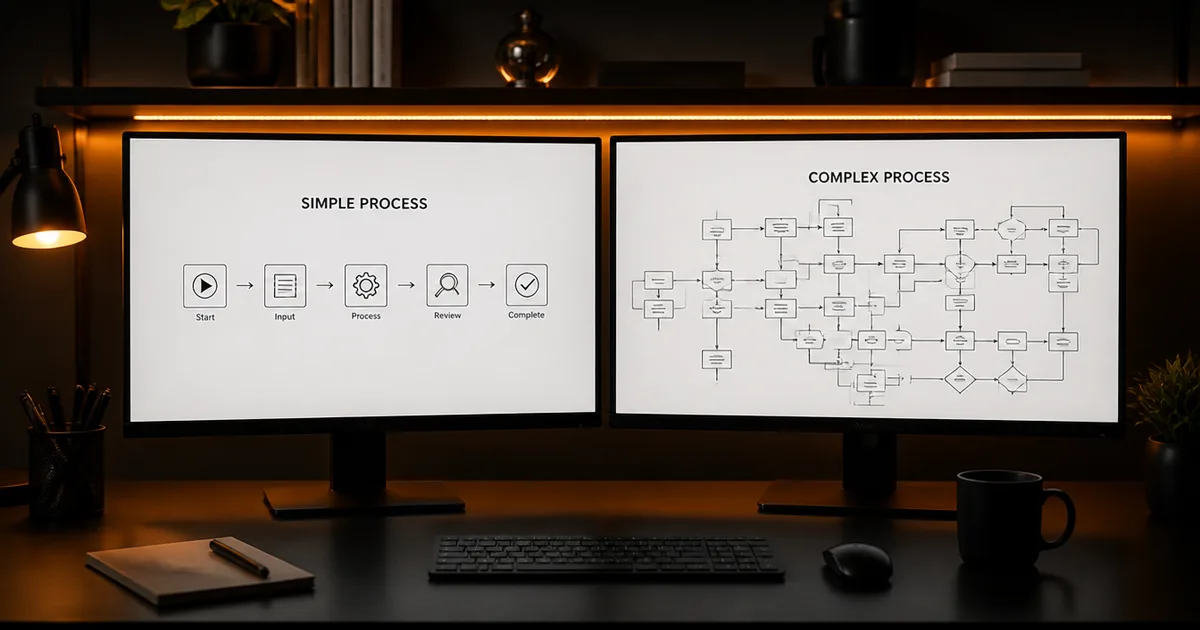
The two terms get used as though they name competing products. They do not. An AI agent is a thing; agentic is a property that thing has more or less of. One is a noun, the other an adjective, and most of the confusion in buying conversations comes from treating them as a binary.
That matters commercially, because the amount of autonomy you buy is the single biggest driver of what an AI project costs and how likely it is to reach production.
The Definitions, Without the Marketing
An AI agent is a system that takes a goal, decides what steps to take, and acts through tools — APIs, databases, browsers, your CRM. The defining feature is action. If it only produces text, it is a model with a nice interface. If it can change the state of a real system, it is an agent.
Agentic AI describes how much independence that system has. Does it follow a path you defined, or work out its own? Does it notice when a step failed and try something else? Can it decide it needs a tool you did not explicitly tell it to use?
So the honest answer to "agentic AI vs AI agents" is that the comparison is slightly malformed. Every agent is agentic to some degree. The real question is how much — and that is a dial, not a switch.
The Autonomy Spectrum
Four rungs, in ascending order of capability and cost.
Rung 1 — Fixed workflow with AI steps
A deterministic pipeline where a model does the hard part of individual steps. Email arrives → model classifies it → route by classification → model drafts a reply → human approves.
The sequence is fixed. The model provides judgement inside steps, not about which steps to run.
Reliability: high. Cost: lowest. Debugging: trivial, because there is one path.
This solves a genuinely large share of real business problems, and it is where we start most engagements.
Rung 2 — Tool-calling agent
The model chooses which tools to call and in what order, within a defined toolset. Given "what happened with the Henderson account?", it decides to query the CRM, then the support system, then summarise.
Reliability: good, with a bounded toolset. Cost: moderate. Debugging: harder — you are now reading traces to understand why it picked that route.
This is where most production agents live.
Rung 3 — Planning agent
The model decomposes a goal into a plan, executes it, evaluates results, and revises. Given "prepare a briefing for tomorrow's renewal call", it works out what a briefing needs and assembles it.
Reliability: variable, and this is where the honesty threshold sits. Long chains compound error — a small mistake at step two becomes a confidently wrong output at step nine.
Cost: significant, mostly in evaluation and guardrails rather than build.
Rung 4 — Multi-agent systems
Multiple specialised agents collaborating, handing off between roles.
Reliability: hardest to guarantee. Every handoff is a place context degrades. Cost: highest.
Genuinely useful for complex decomposable problems. Rarely the right answer for a business workflow, despite being the most demoed.
The Cost Curve Nobody Mentions
Here is the part that matters for budget: capability rises roughly linearly up those rungs, and the engineering required to make it trustworthy rises much faster.
A rung-1 workflow needs testing. A rung-3 planning agent needs evaluation sets, trace logging, guardrails on every tool, fallback behaviour for each failure mode, and a way to explain after the fact why it did what it did. That surrounding work, not the model integration, is where the budget goes.
This is why so many agent pilots stall between demo and production. The demo shows rung 3. The production requirements were rung 1. The gap is entirely in reliability engineering, and it is usually discovered late.
How to Choose the Right Rung
One question does most of the work:
Is the sequence of steps knowable in advance?
If yes — the same steps, every time, in the same order — you want rung 1. It will be cheaper, faster, more reliable, and easier to hand over. Paying for autonomy on a deterministic task is the most common overspend in this category.
If the path genuinely varies by input, and the variation is the hard part, move up. But move up one rung, not four.
A second question, for anything above rung 1:
What does being wrong cost, and can we undo it?
Cheap and reversible? Grant more autonomy. Expensive or irreversible? Put a human on it regardless of how capable the model is. Autonomy should be earned per action, not granted wholesale.
Where the Terms Come From
Some of the confusion is simply vendor incentive. "Agentic" arrived as a differentiator when every product had already been relabelled "AI-powered", and it means whatever the marketing needs it to mean that quarter. Treat it as a description of autonomy level, ask which rung a given product actually operates at, and the term stops being slippery.
The practical translation, when you see the word in a pitch: ask what it can do without asking permission. That answer tells you the rung, the risk, and roughly the cost.
What We Recommend
Start at rung 1 or 2. Ship something that works. Add autonomy where the fixed path demonstrably fails, not preemptively.
That sounds conservative, and it is deliberately so: the projects we have seen succeed built trust incrementally, and the ones that failed spent it all on an ambitious first release. Organisational trust is the real constraint on AI adoption, not model capability — and unlike the models, it does not improve every six months.
For concrete versions of this, our AI agent examples walks through ten that run in production and where each sits on this spectrum.
We scope AI automation as fixed-fee engagements, starting with a call about which rung your problem actually needs. Often it is lower than expected, which makes the project cheaper and much more likely to ship. Book a scoping call or read about our AI automation practice.